Origin data to filed DDS
EUDR compliance that starts where your plot data actually lives.
Grovetrace pulls supplier and plot data out of the ERPs, farm-data tools and co-op spreadsheets it's stuck in, and ties every cocoa batch to the land it grew on. That becomes the Due Diligence Statement every shipment needs in TRACES from 30 December 2026. Built for cocoa first, and for the six other EUDR commodities that work the same way.
The hard part isn’t the filing
It’s that supplier and plot data live in ERPs, farm-data tools, co-op spreadsheets and email attachments, and they don’t line up. Polygons arrive late, malformed or overlapping, and it’s your submission that fails.
Grovetrace goes deep on exactly two things: getting messy origin data in, and getting an accepted DDS out. Not an ESG suite. Not a certification scheme. One thing, done properly.
- GeometryPoints and polygonsValidated on ingest: validity, hemisphere, range, duplicates, overlaps.
- IsolationOrg-scoped, every queryMulti-tenant by organization, so one operator never sees another.
- EvidenceFive-year audit trailRetained per organization behind every submission, as the regulation requires.
- CoverageAll seven commoditiesCocoa, coffee, palm oil, soy, rubber, cattle and wood share one model.
- TRACESAcceptance round tripA statement taken end to end against the EU pre-production system.
Built for cocoa first
Plenty of tools claim cocoa. The difference shows up in the parts that are tedious to get right, the ones that decide whether a DDS can actually be filed for a real, blended shipment.
Thousands of tiny plots
Smallholder farms under 4 ha are points, not polygons, under the regulation. In Ghana, Côte d’Ivoire, Ecuador, Peru, Cameroon and Nigeria, plot data arrives from co-ops in whatever shape the co-op keeps it, and it still has to reconcile.
Aggregation and blending
Beans from many farms become one lot, one container, one shipment. Grovetrace models the join explicitly, so a filed DDS can name every plot behind a blended batch.
Co-ops sit in the middle of the chain
Your supplier is usually a cooperative, not the farmer. Grovetrace records the consolidation step itself (farmer batch, co-op, exporter) so the plots behind a co-op delivery stay traceable instead of disappearing at the point of aggregation.
The systems cocoa actually runs
Field-data tools, ERP exports and co-op spreadsheets, ingested where they are. No rip-and-replace, because origin will not adopt your software.
How it works
The filing is a form. The hard part is everything upstream of it, which is what Grovetrace is actually for.
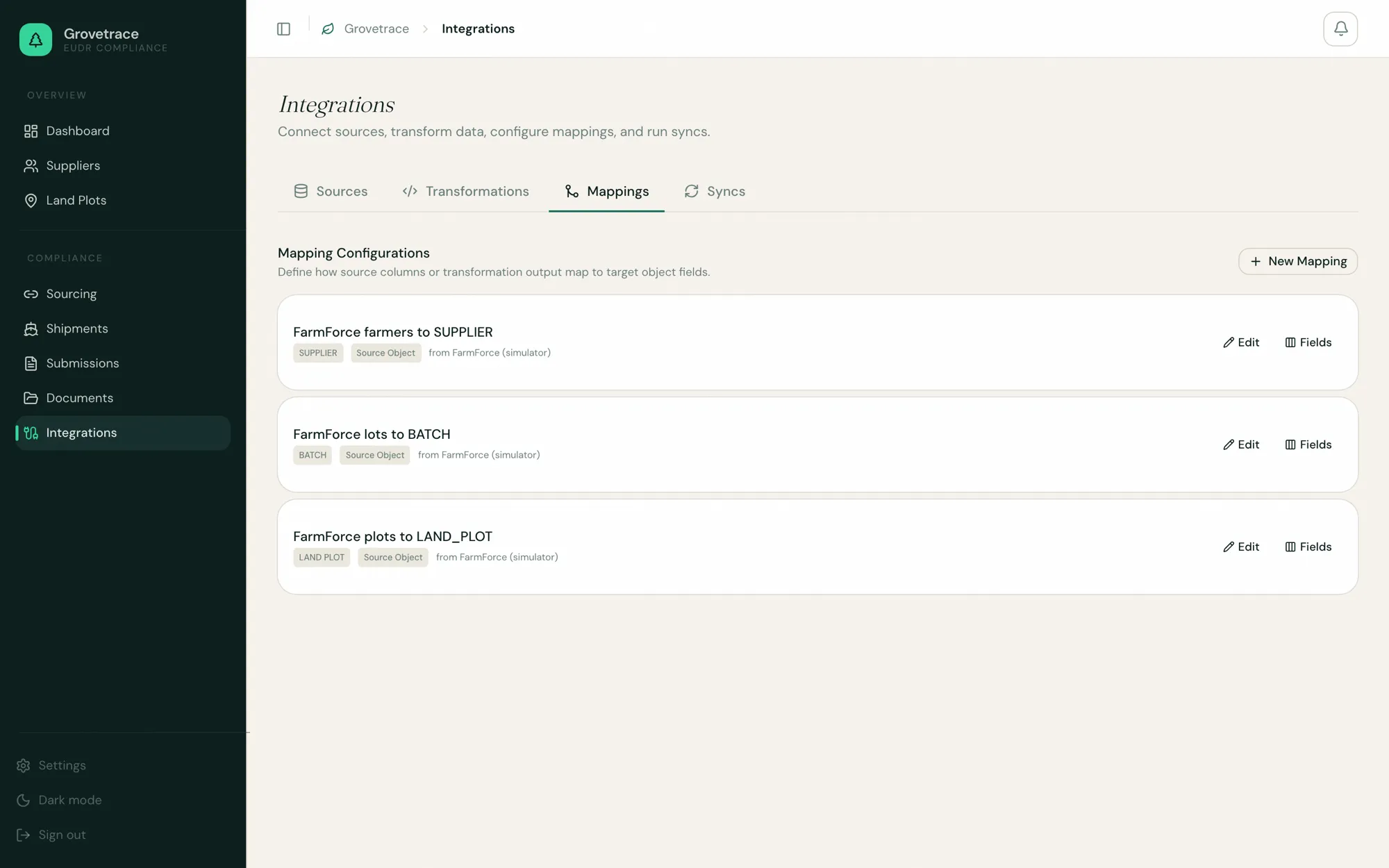
Connect the systems you already run
Field-data tools, ERP exports, co-op spreadsheets, CSV. You map each source once (farmers to suppliers, plots to land plots, lots to batches) and Grovetrace keeps pulling. Origin never has to adopt your software, because nothing about their process changes.
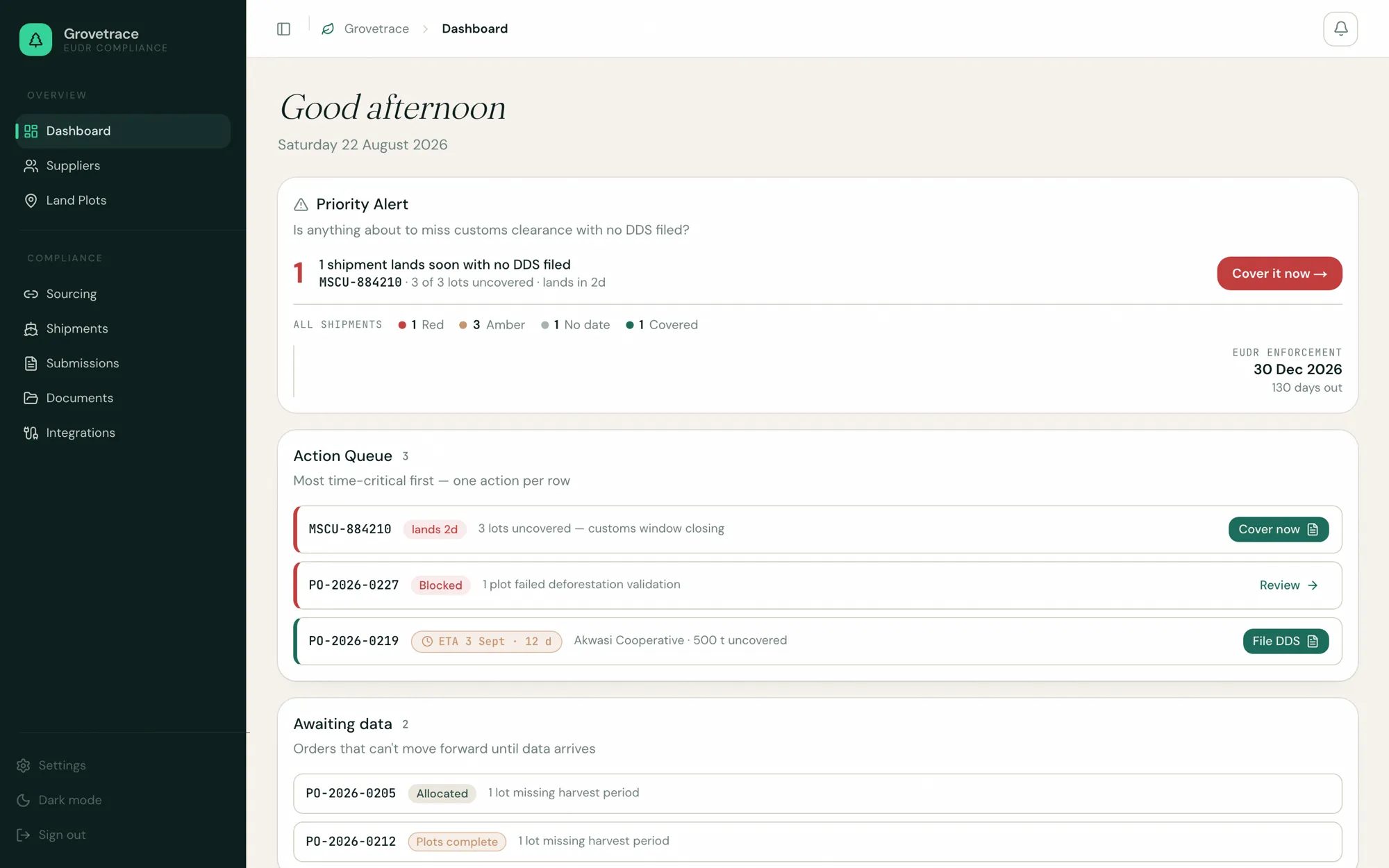
Log in and see exactly where you stand
One question answered on arrival: is anything about to miss customs clearance with no DDS filed? Every shipment sits in red, amber or covered, with the enforcement date counting down beside it. No report to run, no spreadsheet to reconcile.
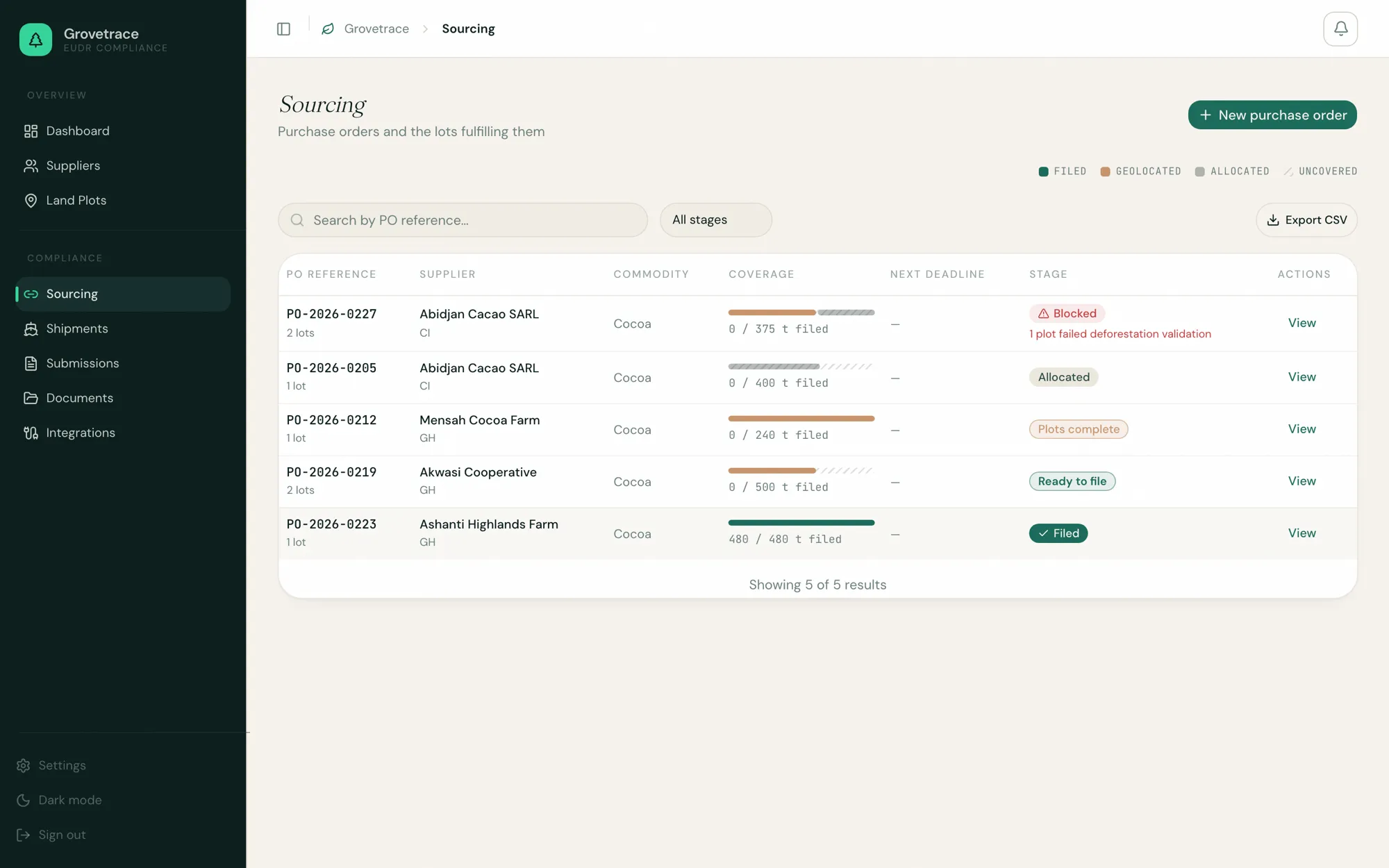
Work one action at a time
The action queue is ordered by what runs out of time first, one action per row: cover this shipment, review this blocked plot, file this statement. Orders that cannot move sit separately under what they are waiting for, so nothing looks urgent when it is merely stuck.
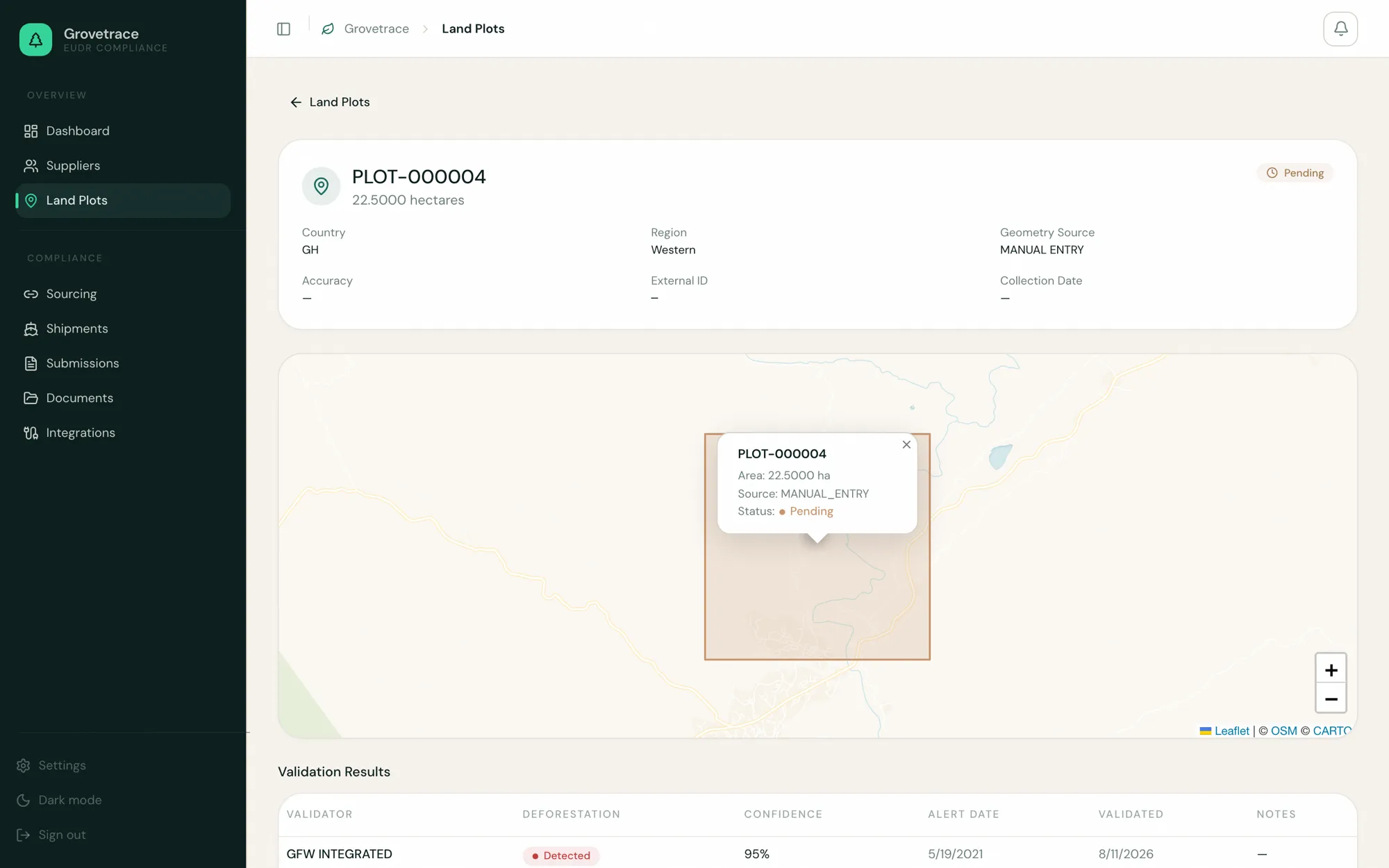
Every batch ties back to the land
Plot geometry, the validation result behind it, and the batches it feeds, held together rather than sitting in three systems. When a statement is challenged years later, the evidence is one click from the shipment, not a reconstruction.
What Grovetrace does
- Ingests your data where it livesSupplier and plot data from the systems you already run: ERP exports, farm-data platforms, CSV. No rip-and-replace.
- Ties every batch to the land it came fromGeolocated plots (points and polygons), batch-to-plot traceability across aggregation and blending.
- Records the compliance conclusion per shipmentDeforestation-risk and legality assessment, captured with its evidence.
- Generates and submits the DDS to TRACESThe regulated output, submitted, with the reference stored.
- Keeps the audit trailFive-year, per-organization evidence trail behind every submission.
Multi-tenant platform built for smallholder tree-crop supply chains, cocoa first. Running against the TRACES acceptance environment today.
Questions people actually ask
Does the December 2026 deadline actually apply to me?
It depends on your size, and the two cohorts have different dates. Large and medium operators and traders are in scope from 30 December 2026. Small and micro enterprises follow on 30 June 2027.
If you place cocoa, coffee, palm oil, soy, rubber, cattle or wood, or products derived from them, on the EU market, or export them from it, the regulation is aimed at you. Which cohort you sit in is a question for your own counsel; it turns on your company size, not on your volume of any one commodity.
What counts as geolocation for a smallholder farm?
A point is sufficient for a plot below 4 hectares. Above that you need a polygon describing the plot boundary.
This is the detail that quietly breaks cocoa programmes. A co-op collecting points for every farm is fine right up until a farm turns out to be 4.2 ha, and then the point that was collected two seasons ago is not the evidence you need. Grovetrace validates geometry on the way in, checking validity, hemisphere and range, duplicates and overlaps, so the gaps surface months before a submission window rather than inside one.
Do I have to replace the systems I already use?
No, and you should not have to. Grovetrace connects to what you run: ERP exports, field-data platforms, co-op spreadsheets, CSV. It maps each source once onto its own model: farmers to suppliers, plots to land plots, lots to batches.
That matters most at origin. A cooperative in Ghana is not going to adopt your compliance software, so the data has to be ingested in whatever shape it already arrives in.
Our plot data arrives in four different formats. Is that a problem?
That is the normal case, and it is the specific problem Grovetrace was built for. Each source gets its own mapping, so thirty origins sending thirty conventions still resolve to one set of suppliers, plots and batches.
The harder half is identity: the ERP has a vendor code, the field tool has a farmer ID, and the co-op spreadsheet is keyed on a name spelled three ways. Grovetrace resolves those to one supplier and one plot rather than leaving you to reconcile them per shipment.
What about blending? Our lots come from many farms.
Aggregation is modelled explicitly rather than flattened. Beans from many farms become one lot, one container, one shipment, and the link from each batch back to the batches that fed it is kept, so a filed statement can still name every plot behind a blended consignment.
Traceability that survives the blend is the difference between a statement you can defend and one you hope is not examined.
What happens if TRACES rejects a statement?
The rejection and its reason are recorded against the statement, and the shipment returns to the worklist as something to act on rather than disappearing into an inbox. You fix the underlying data and resubmit.
Most rejections trace back to the same few fields being absent or imprecise, which is why the product spends its effort upstream of the filing.
Is this only for cocoa?
The platform is commodity-generic. All seven EUDR commodities work the same way, and running cocoa and coffee through one compliance function rather than two is a common reason people come to us.
Cocoa is where the depth is, because cocoa is where the hard parts concentrate: thousands of smallholder plots, co-ops in the middle of the chain, and aggregation before export.
How far along is Grovetrace?
Early, and stated plainly: the platform is working software running against the TRACES acceptance environment, the EU's pre-production system, and it is not yet a finished product with a list of reference customers.
That is the trade. A design partner gets founder-level access, real influence over what gets built, and co-development pricing, in exchange for working with something still being shaped. If you need a finished product today, we are not the right fit yet, and saying so early saves us both a quarter.
See it on your own supply chain
Twenty minutes, screen shared. Bring the part of your data that worries you most: thirty co-op formats, plots that will not reconcile, a blend nobody can trace back. That is the useful version of this call.
Book a demoTaking one design partner before December. Twelve weeks, and the test is whether your compliance officer produces a statement that is accepted.